Why Organizational Problems Are Usually Systemic - And Why Most Measurement Tools Miss the Point
This is part of a series on organizational health. I begin with the foundations and move step by step toward how this takes form in practice. This is article 2.
When organizations begin to struggle, the explanations tend to follow familiar patterns. A team underperforms, a project fails, culture begins to deteriorate, and stress levels rise as people start to leave. In response, most organizations instinctively reach for one of a few standard explanations. The issue is treated as an exception - an isolated incident rather than a signal of something deeper. Or the focus shifts to individuals: someone made poor decisions, a manager failed, or certain employees lacked competence or motivation. In other cases, the problem is framed as one of communication, leading to new value statements, updated policies, or workshops on leadership and culture. While these responses may feel reasonable, they rarely address the underlying cause.
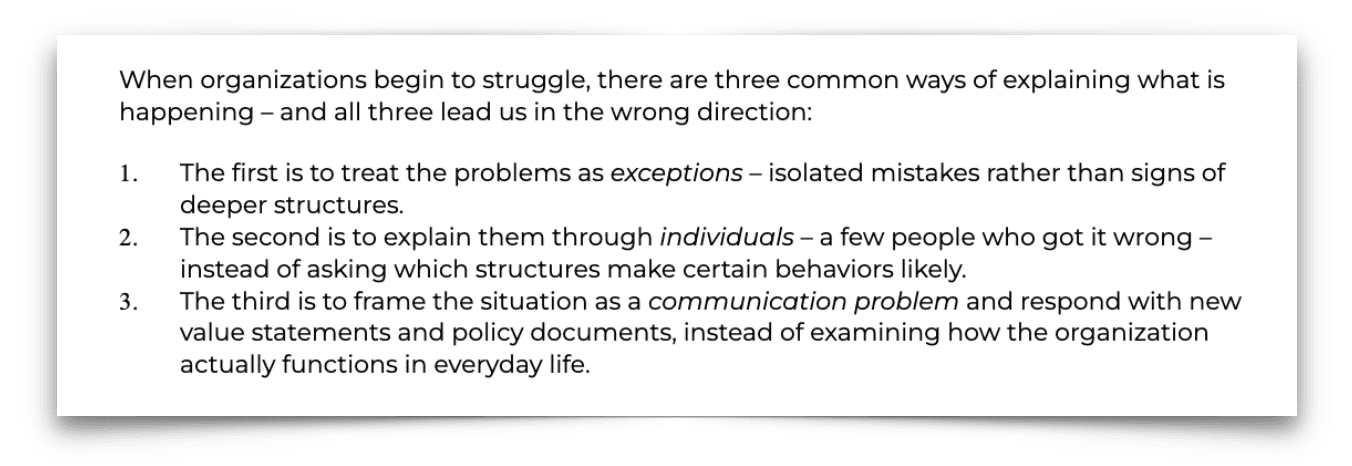
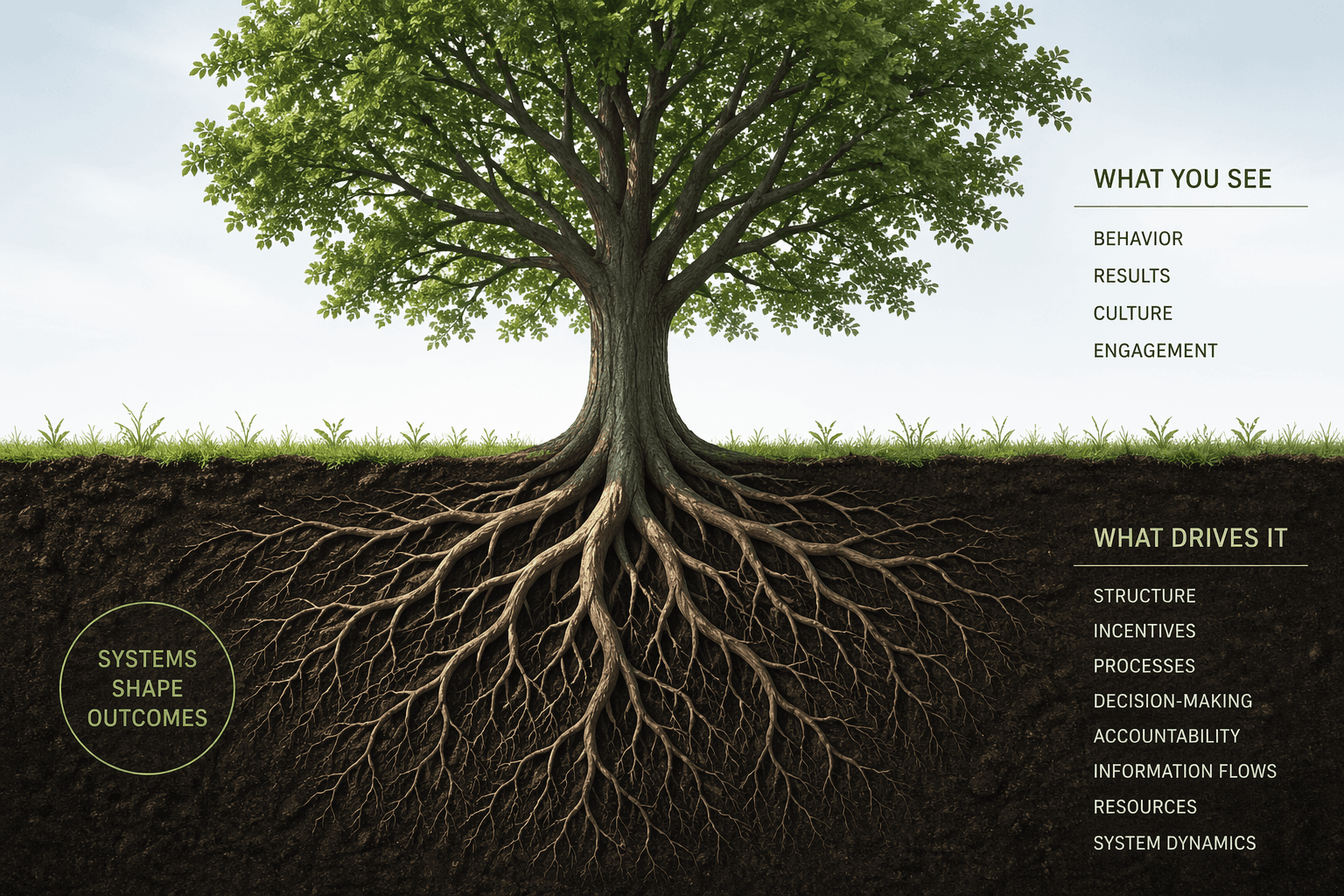
In reality, organizational problems are seldom, in the first instance, about individuals or communication. They are systemic. They emerge from how the organization is designed rather than from the intentions of the people within it. Structures shape behavior far more powerfully than we tend to admit. Incentives, governance models, reporting lines, and performance metrics all influence how people act, often in ways that directly contradict the organization's stated values. A culture of short-term thinking, for example, does not arise because people suddenly become less responsible; it emerges because the system consistently rewards short-term outcomes more strongly than long-term accountability. Similarly, fear within an organization does not appear because people lack courage, but because the system punishes transparency more than silence.
This misalignment between stated intentions and actual structures is what makes organizational change so difficult. When problems are interpreted as individual failures, the response is to replace people or invest in training. When they are seen as communication issues, organizations introduce new values, policies, or leadership frameworks. However, if the real issue lies within the system itself, these interventions leave the underlying dynamics untouched. As a result, organizations often find themselves caught in a repeating cycle where problems emerge, interventions are introduced, and the same problems eventually return in a different form. Nothing changes at a fundamental level because the conditions that produce the behavior remain intact.
Breaking this pattern requires a shift in perspective, often described as systemic thinking.
Instead of asking what went wrong, organizations need to ask what in the system made the outcome likely in the first place.
This shift may seem subtle, but it fundamentally changes where attention is directed. It moves the focus away from individuals and toward the relationships between structures, incentives, and behaviors. It raises questions about how decisions are made and followed up, how accountability is distributed, how information flows, and where contradictions exist between what the organization says and what it actually rewards.
The measurement problem
Yet even when organizations embrace systemic thinking, they often lack the tools to act on it. Most employee surveys are designed to capture how people feel: "are you satisfied, engaged and well-being?" This without examining the organizational conditions that produce those feelings. The result is a picture of symptoms rather than causes. Knowing that engagement is low or stress is high does not, in itself, reveal whether the issue originates in unclear roles, weak feedback structures, inadequate staffing, or a leadership culture that avoids conflict. Without that level of specificity, interventions remain generic - and the cycle continues.
This is where the choice of measurement instrument becomes critical. A tool that only captures individual experience will consistently lead organizations back to individual explanations. To think systemically, you need to measure systemically.
Measuring the system, not just the symptoms
A really good example is the Whole-model, developed through more than 30 years of research at Linköping University in Sweden. It was built to address precisely this gap. Unlike conventional surveys, Whole measures both individual work experience and organizational functioning simultaneously - and, crucially, the validated connections between them. It covers leadership, cooperation, role clarity, goal structures, staffing, social work environment, and several other dimensions, each grounded in established theoretical frameworks.
The instrument distinguishes between how individuals experience their work situation and how the organization actually operates at a structural level. This dual perspective is what makes systemic analysis possible. When low energy or declining engagement appears in the data, Whole does not simply report it - it reveals what in the organizational system is driving it. Perhaps roles are ambiguous, perhaps the leadership structure lacks the mechanisms for constructive feedback, or perhaps staffing levels are insufficient relative to expectations. These are structural questions, and they require structural data.
From insight to change
Understanding organizational health through this lens challenges common assumptions. Health is often reduced to culture or employee satisfaction, but in practice, it is a property of the system itself. It reflects how well the organization's structures support clarity, accountability, and sustainable performance. Questions about whether decision-making processes are clear or ambiguous, whether accountability creates ownership or avoidance, and whether desired behaviors are genuinely reinforced cannot be answered through intuition alone. They require a structured understanding of how the organization actually operates.
Adopting a systemic perspective is not easy. It shifts responsibility away from individuals and toward structures, which can feel uncomfortable. It challenges leaders to question not just what people are doing, but how the organization itself is shaping those actions. This is significantly more demanding than replacing individuals or refining communication, because it requires confronting the design of the system itself. Yet this is precisely where meaningful and lasting change begins.
Organizations, ultimately, produce the outcomes their systems are designed to produce. As long as systemic problems are addressed with individual or communicative solutions, the results will remain largely unchanged. And as long as measurement tools only capture how people feel without revealing why the system produces those feelings, the insight needed for genuine change will remain out of reach. Only by understanding and redesigning the system behind the behavior can organizations create the conditions for genuine and sustainable health.


The Economy of Trust

When the Company Is No Longer at the Center

Impact & Value Creation - When Value Actually Becomes Value

Operation & Finance - Stewardship in Practice
Board & Governance - Guardians of Purpose and Responsibility

People & Values - The Inner Life of an Organization

Strategy Needs More Than Smartness

The Mission & Vision Dimension of the GreenGardens® Model

Restoring Dignity to Organizational Life
Why Organizational Problems Are Usually Systemic - And Why Most Measurement Tools Miss the Point
