Board & Governance - Guardians of Purpose and Responsibility
"Board & Governance serve as guardians of purpose and responsibility. They provide oversight, counsel, and accountability, ensuring that the organization acts with integrity and faithfulness to its mandate. Sound governance creates stability, wisdom, and trust over the long term."
Board & Governance is one of the eight dimensions in the GreenGardens® model of organizational health. It is also one of the dimensions most often reduced to something far narrower than what it truly encompasses.
In many organizations, board work is primarily viewed as a formal requirement, a legal necessity, and a structure for making decisions that cannot be made elsewhere. Auditors, meeting minutes, bylaws, annual reports - these are all obvious and important elements. They each have their place. Yet if this is our entire picture of governance, we have missed something essential.
There is a Latin concept from classical political philosophy that captures something rarely found in modern governance documents: prudentia. It refers to the practical wisdom that enables sound judgment in concrete situations. Aristotle used the Greek term phronesis and carefully distinguished it from both technical expertise and theoretical knowledge. Phronesis is neither engineering skill nor philosophical speculation. It is the ability to discern what ought to be done in a particular situation, taking into account the whole, the people affected, and what is most deeply aligned with the organization’s calling.
In its deepest sense, governance is about precisely this. It is not merely about ensuring compliance with rules or making sure processes function as intended. It is about safeguarding the organization’s credibility, taking responsibility for its long-term development, and remaining faithful to its purpose even as circumstances change.
This insight challenges a narrow understanding of governance. A well-functioning board is not primarily a control body observing the organization from a distance. It shares responsibility for ensuring that the organization remains whole in its identity, integrity, and direction. Board service, therefore, is not only about oversight; it is also about judgment.
A number of organizational thinkers have sought to describe the forces that shape organizations beyond formal structures and processes. One of the most influential contributions is Bolman and Deal’s classic work Reframing Organizations. In it, organizations are understood through four perspectives: the structural, human resource, political, and symbolic frames. Although Bolman and Deal do not primarily write about governance, their model offers valuable insights into the board’s role.
The political and symbolic perspectives are particularly helpful in understanding dimensions of governance that are often overlooked. The political perspective draws attention to how power is distributed, how conflicts are managed, and how resources are allocated in ways that are legitimate and thoughtful. The symbolic perspective reminds us that a board does more than make decisions. It also signals what the organization values. What receives attention in the boardroom, what is given time and reflection, and which questions are considered important enough to examine critically all communicate what the organization truly regards as significant. In this way, governance shapes not only organizational decisions but also organizational culture and self-understanding.
This leads us to a question that, I believe, belongs in every boardroom:
In what way are we good for the world?
This is a question I took with me from the Integral Economics program. If we cannot answer it, on what grounds can we claim our place in the world?
Much of what goes wrong in boardrooms is not the result of ignorance or incompetence. Rather, it happens when attention turns inward: toward shareholder returns, organizational survival, or institutional self-interest. This is human, but it is not enough. One of the board’s most important responsibilities is to keep the larger question alive and to ensure that the organization’s mission is not reduced to mere self-preservation.
A board that takes this responsibility seriously does not ask only: Have we complied with the rules? It also asks: Have we acted in a manner worthy of what we claim to be? Have we served those we exist to serve? Have we been faithful stewards of what has been entrusted to us?
In the GreenGardens® model, Board & Governance is described as guardians of purpose and responsibility. This means ensuring that purpose is neither forgotten, distorted, nor gradually replaced by something else without anyone consciously deciding it. It means asking uncomfortable questions, keeping institutional memory alive, remembering where the organization came from, what it promised, and why it chose a particular direction in the first place. It requires steadiness rather than rigidity, and a continuity that allows the organization to remain true to itself even under pressure.
The question then becomes: what enables a board to carry this responsibility in practice?
Formal mandates and well-written governance documents are important, but they are not enough. Ultimately, governance depends on the people in the boardroom and on their ability to work together around a shared purpose. Here, Patrick Lencioni offers an important perspective.
Lencioni argues that trust is the foundation of all effective collaboration and that the absence of trust is the first and most fundamental obstacle to genuine team performance. In the boardroom, this trust is particularly fragile because it must be built among people who meet relatively infrequently and who operate at the intersection of ownership interests, organizational realities, and external expectations. Building such trust requires time, honesty, and a shared understanding of what the board has actually been called together to accomplish.
A healthy boardroom is not a boardroom without conflict. It is a boardroom that handles conflict with integrity, that can carry tension without losing direction, that can challenge management without paralyzing it, and that can give management the freedom to lead without relinquishing its own responsibility. It is in this capacity that trust is either strengthened or weakened. This is precisely why the GreenGardens® model expresses the insight so succinctly:
The healthy organization starts in the boardroom.
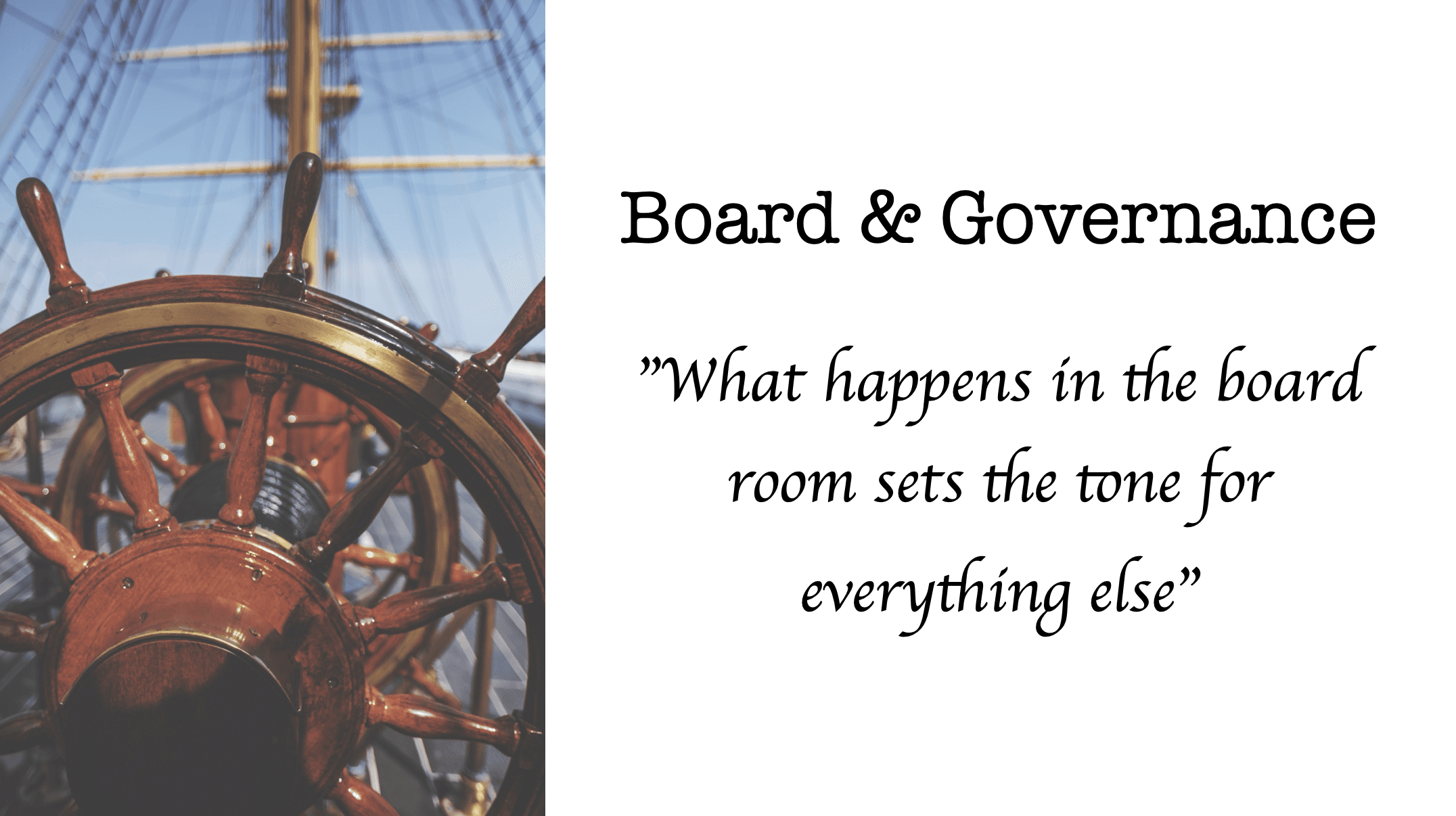
I am convinced that this is true. Not because the board is the most important part of the organization - there is no such part - but because what happens in the boardroom sets the tone for everything else. It can create a culture in which responsibility and integrity are real, or one in which silence and self-interest gradually take over. Cultures always begin somewhere. That is why the quality of leadership and collective deliberation matters so profoundly.
The Book of Proverbs expressed this insight three thousand years ago:
"Without guidance a people falls, but with many advisers comes success."
The principle is as true for organizations as it is for nations. The point is not that people need a strong leader who makes every decision. On the contrary, the proverb reminds us that individuals, organizations, and societies risk losing their way when decisions are made without wisdom, reflection, and counsel. The alternative is the presence of many advisers - people who contribute perspective, experience, and judgment.
It is as true today as it was then.

The Economy of Trust

When the Company Is No Longer at the Center

Impact & Value Creation - When Value Actually Becomes Value

Operation & Finance - Stewardship in Practice
Board & Governance - Guardians of Purpose and Responsibility

People & Values - The Inner Life of an Organization
Strategy Needs More Than Smartness

The Mission & Vision Dimension of the GreenGardens® Model

Restoring Dignity to Organizational Life
Why Organizational Problems Are Usually Systemic - And Why Most Measurement Tools Miss the Point
