Impact & Value Creation - When Value Actually Becomes Value
"Impact & Value Creation focuses on understanding and improving the results the organization creates. It shifts attention from activity alone to meaningful outcomes for people, communities and society. By measuring, reflecting, and learning, the organization strengthens effectiveness, accountability, and continuous improvement." (one of the dimensions in the GreenGardens® model)
For a long time, one of the most influential ideas in business has been that a company's primary task is to maximize value for its owners. The idea gained its breakthrough during the 1970s and 80s, at a time when capital was scarce and economic growth was seen as the path to societal development. But we no longer live in the same world. Today, capital is in many places no longer the scarcest resource. What is increasingly scarce is natural resources, trust, social cohesion, human energy, and functioning relationships. Yet many organizations are still run as if capital were the only real constraint.
That may be why the word impact has become so important. We talk about sustainability, ESG, social value, and long-term effects, but the words risk living a life of their own, disconnected from the reality they're meant to describe. Because the crucial question isn't whether an organization claims to create value. The crucial question is what actually changes because the organization exists. Who is strengthened? Who bears the cost? Who gains greater ability to take responsibility for their own lives, and who is made more dependent on systems they cannot influence themselves?
Impact & Value Creation is one of eight dimensions in the GreenGardens® model for organizational health. It's about shifting attention from activity to actual impact - from what we do to what our doing leads to. An organization can be highly active, run projects, and communicate good intentions, while the deeper question remains unanswered: does the world become more whole through what we do?
All organizations affect their surroundings, shape relationships, and distribute responsibility, resources, and risk, whether or not they are aware of it. The question, then, is not whether we have an impact, but whether we understand it and take responsibility for it.
This is where the stakeholder perspective becomes crucial. In many organizations, the word is used frequently. People talk about customers, employees, owners, suppliers, partners, and society. But the real test isn't whether stakeholders appear on the map, it's whether they get to shape the organization's understanding of success. A stakeholder-oriented organizational logic isn't just about identifying those who matter to us. It's about seeing everyone affected by us, including those without a strong voice, who aren't at the table, and who don't appear in the organization's usual decision-making basis.
This challenges the notion that an organization's primary task is to maximize owner value. This challenges the notion that an organization's primary task is to maximize owner value. That doesn't mean profitability is unimportant - quite the opposite; an organization that doesn't sustain itself economically will sooner or later lose its ability to carry out its mission. But when owner interest becomes the sole yardstick, something happens to the whole, and it happens gradually, almost imperceptibly. People easily become costs. Relationships become means. Nature becomes a resource. The local community becomes surroundings. What is in fact a mutually dependent ecosystem is reduced, step by step, to an economic flow. What can then look like value creation on the surface is in practice often about shifting costs to where they're harder to see. Profit arises somewhere, but the burden lands on pressured suppliers, exhausted employees, or weakened communities.
The Just Coffee example
One of the clearest examples of a different way of thinking came from a conversation with Amos Ssekigudde, agronomist and leader of the work with Just Coffee in Uganda. Just Coffee is both a social and commercial coffee initiative aimed at reducing poverty and creating long-term sustainable livelihoods for smallholder farmers. This isn't done through short-term charity, but through education, agricultural development, market access, and a business model where coffee production becomes a path to dignity, responsibility, and hope for the future.
What struck me was how Amos talked about the value chain. He didn't start with the customer somewhere out in the world, or the brand - he started with the farmer. If the farmer doesn't get the right support, the harvest is affected, the quality is affected, the income is affected, the family is affected, the children's schooling is affected, and ultimately the coffee the consumer drinks is affected. This isn't a linear process where a raw material moves from producer to market, but a network of relationships where each link depends on the others. Around the farmers are local traders, exporters, suppliers, authorities, and customers. Everyone affects everyone else. That's why ethics, transparency, and fairness aren't something alongside the business - they're part of the business itself. Protecting farmers from exploitation and ensuring they receive fair value for their coffee isn't just an economic question, but a moral one.
This becomes even clearer when Amos talks about dignity. He describes how traditional models of child support in Africa, despite good intentions, can sometimes have unintended consequences. When organizations pay school fees directly for children, parents can be sidelined. At graduation ceremonies, the children thank the organization while the parents sit silently in the audience. What was meant to help risks simultaneously weakening the parents' role, responsibility, and pride.
Just Coffee tries to take a different path. Rather than bypassing the parents, it strengthens their ability to support their own families. Through education, better farming methods, the right coffee plants, production support, and an actual market for the coffee, parents gain the ability to pay school fees themselves, improve their homes, and take responsibility for their children's future.
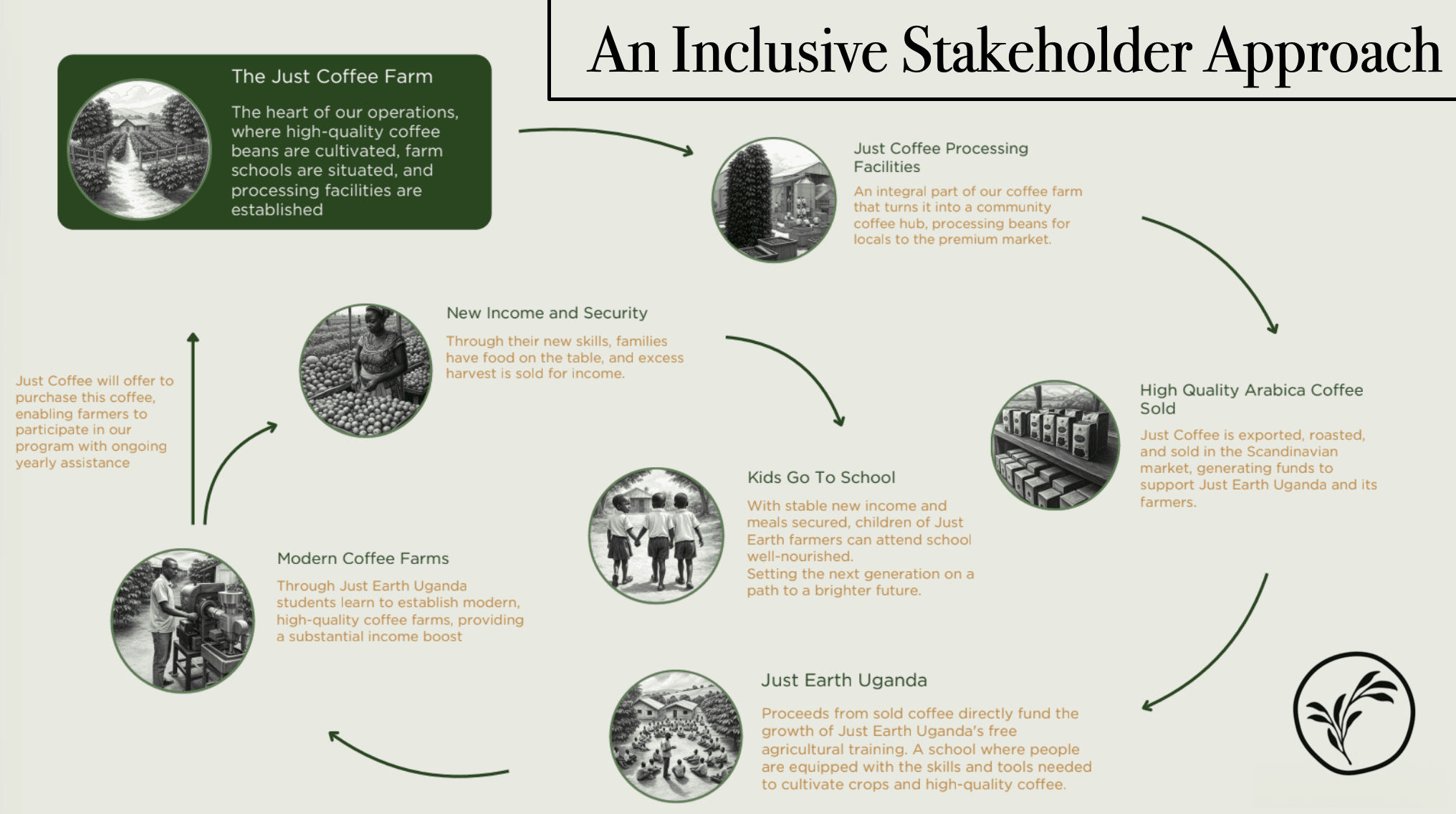
This is where impact becomes something more than a performance metric. It's not just about higher income, more children in school, or better coffee. It's about relationships being restored, responsibility returning, and dignity being strengthened. This is also the difference between charity that relieves and value creation that builds capacity. One can respond to an urgent need. The other tries to change the underlying conditions so that people themselves become agents in their own future.
Getting measurement right
Impact & Value Creation therefore cannot be reduced to ESG, sustainability reporting, or stakeholder mapping, even though these can be important tools. The core of it is deeper: it's about the responsibility for the reality the organization creates - daring to follow value all the way out into the world around it.
At the same time, we mustn't become romantic about it. Good intentions aren't enough. Amos himself points to the need for more systematic follow-up and independent evaluation. If we say we create value, we need to be willing to examine whether that's true. But measurement must remain a tool, not a goal in itself. If we only measure what's easy to measure, we'll soon start steering toward what's easy to show off, and then we risk losing sight of what's often more decisive: trust, responsibility, dignity, hope for the future, relationships, and meaning. Impact work needs both numbers and stories.
In First Corinthians there's a phrase that captures this:
"No one should seek their own good, but the good of others."
It's a statement that runs directly against much of our era's economic self-understanding, but perhaps it's more realistic than it first appears. Because no organization becomes healthy in the long run by only seeking its own good. An organization is always embedded in relationships, dependencies, and context, and the healthy organization understands this. It understands that genuine value creation strengthens the very ecosystem the organization itself is part of.
That's why Impact & Value Creation isn't primarily about showing that an organization does good. It's about letting the organization's stated purpose meet reality. What do we say we create? And, even more importantly: what actually happens to people because of us?
Perhaps it's only when we dare to ask that question that value truly becomes value.

The Economy of Trust

When the Company Is No Longer at the Center

Impact & Value Creation - When Value Actually Becomes Value

Operation & Finance - Stewardship in Practice
Board & Governance - Guardians of Purpose and Responsibility

People & Values - The Inner Life of an Organization
Strategy Needs More Than Smartness
The Mission & Vision Dimension of the GreenGardens® Model
Restoring Dignity to Organizational Life
Why Organizational Problems Are Usually Systemic - And Why Most Measurement Tools Miss the Point
