The Economy of Trust
I have once again listened to some fascinating teaching from the Integral Economics program I am attending at the University of Fribourg in Switzerland. This time, I was particularly struck by the Italian economist and professor Luigino Bruni’s thinking on trust.
We are building increasingly sophisticated systems to reduce risk. We measure, monitor, write contracts and create processes to make sure that people do what they are supposed to do. Much of this is necessary. Organizations need structure, clarity and accountability. At the same time, there is something that almost no organization or economy can function without, and that can never be fully built into a system: trust.
We rarely think about how much of our economic life depends on the assumption that other people will do their part. We eat at a restaurant before we pay, send an invoice and expect the customer to pay it, delegate tasks without checking every step and give people responsibility for customers, information and resources. Bruni describes trust as something like the soul of the market. When it is present, we hardly notice it. When it is missing, almost everything becomes more complicated.
This raises a question that I find particularly relevant for businesses and organizations: What happens when our efforts to reduce risk also begin to reduce the space for trust?
When a model becomes a view of the human person
During the nineteenth century, the idea of homo oeconomicus emerged: the human being as a rational economic actor who acts according to self-interest and seeks to maximize personal utility. As an economic model, it has been useful. The problem arises when the model also begins to become our view of the human person.
Human beings naturally have their own interests and make rational choices, but we are also relational, responsible, generous, vulnerable and dependent on others. As economics became increasingly mathematical, things such as relationships, trust, faithfulness and responsibility became more difficult to capture. What could be modelled was given more space, while what was harder to measure risked being left out.
But real people do not always behave like homo oeconomicus. We often seem more willing both to trust others and to reciprocate their trust than the model predicts.
The part of the story we easily miss
Bruni illustrates this through the story of the Good Samaritan in the Gospel of Luke. A man is attacked and left half dead by the roadside. Several people pass him by, but a Samaritan stops. He treats the man’s wounds, puts him on his own animal and takes him to an inn.
The story could almost end there. One person sees another person in need and helps him. But Bruni draws attention to what happens next. The following morning, the Samaritan gives two denarii to the innkeeper and asks him to continue caring for the man. If it costs more, the Samaritan promises to pay the difference when he returns.
Suddenly, there is an economic relationship in the middle of one of the Bible’s best-known stories about care for one’s neighbour. There is money, work to be carried out and a promise of future payment. The Samaritan does not expect the innkeeper to work for free. Instead, the economic relationship becomes part of what allows the care to continue.
But it is above all the trust between them that interests Bruni. The Samaritan leaves both the injured man and his money with someone he cannot control. He makes himself vulnerable. Bruni calls this vulnerable trust. The Samaritan trusts the innkeeper even though he cannot know for certain what the innkeeper will do.
At the same time, the trust works in the other direction. The innkeeper receives a seriously injured man and is promised that any additional costs will be paid later. He has no guarantee either. Both therefore enter into the relationship knowing that the other person could let them down.
That is precisely what makes it trust. If all risk had been eliminated, there would be no need for trust.
The safe choice creates nothing
Bruni analyses this using what behavioural economics and game theory call The Trust Game. In simplified terms, there are two people, A and B. A first has to decide whether to trust B. If A does not, the game stops at 0,0. No one risks anything, but no exchange takes place either.
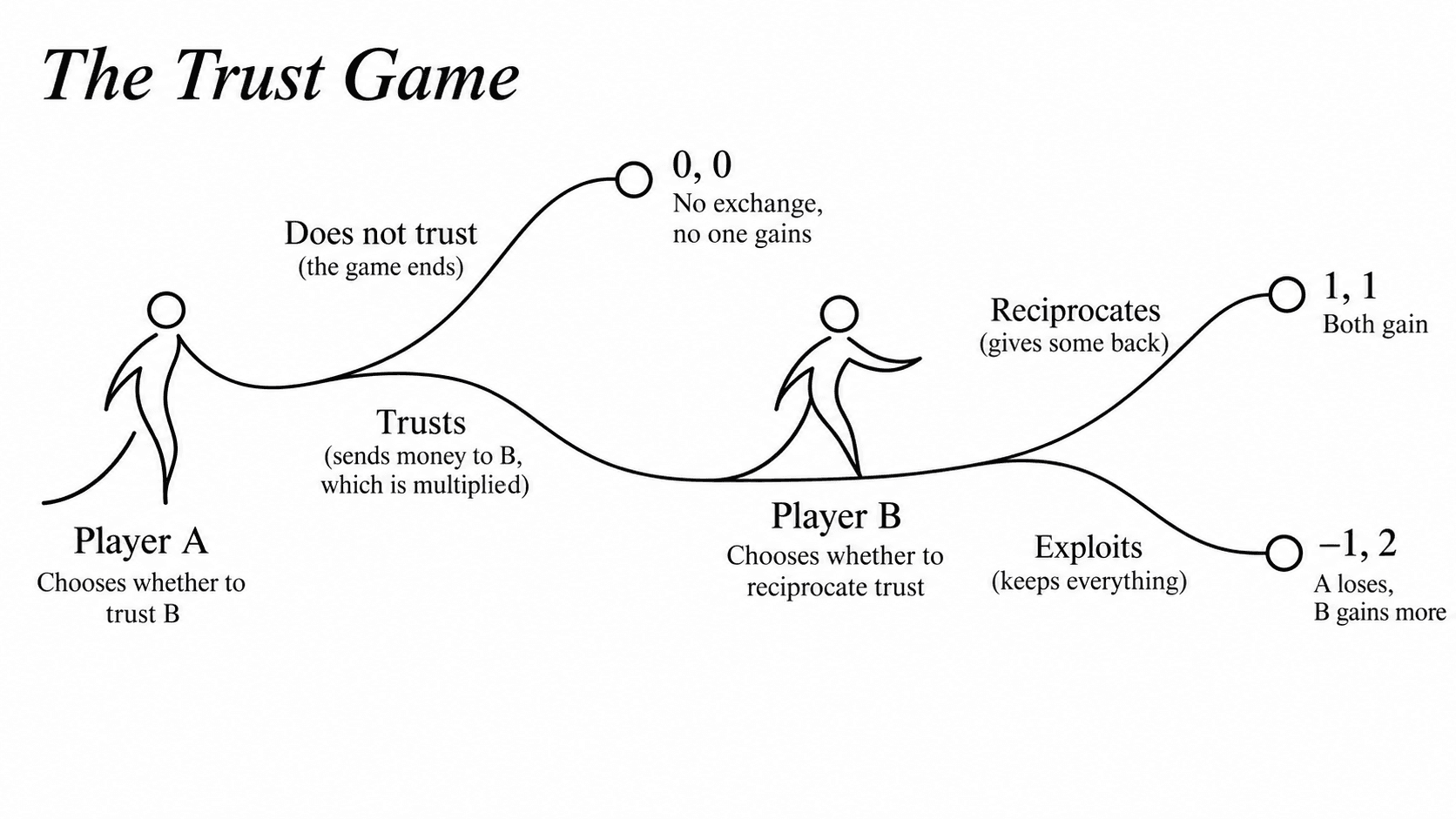
If A chooses to trust B, however, B then has a choice. B can reciprocate the trust so that both receive a positive outcome, 1,1. Or B can exploit the situation and achieve a better outcome personally while A loses.
If both act according to a strictly self-interested model, B should choose the option that benefits him most. A can anticipate this and therefore should never take the risk in the first place. The result is 0,0. It is safe, but no value is created through the relationship.
When real people play the Trust Game, however, something different happens. In the experiments Bruni refers to, around 70–75 per cent of the A players choose to trust the other person, and a large majority of the B players reciprocate that trust. In other words, people often choose the outcome that is better for both rather than the possibility of gaining more for themselves.
This is where I find the connection to organizations particularly interesting. If we always choose the option that minimizes risk, we may at the same time close the door to things that can only emerge through cooperation. Trust involves risk, but trust is also what makes certain forms of value creation possible.
Trust can also create trustworthiness
Bruni’s research points to something even more challenging. In one experiment, students played the Trust Game in two rounds. After the first round, it was known which people had reciprocated trust and which had not. In the next round, some participants nevertheless chose to trust someone who had previously shown themselves to be untrustworthy. Those who were trusted again then became more likely to reciprocate that trust than they had been the first time.
Trust therefore does not have to be only the result of someone already having shown themselves to be trustworthy. Under certain conditions, trust can also help to create trustworthiness.
This is an idea worth taking seriously in organizations. We often assume that people first need to prove that they can be trusted before they can be given more responsibility. But the relationship can also work in the opposite direction. Someone placing trust in me can affect how I choose to act. Trust can awaken a sense of responsibility.
This does not, of course, mean that control is wrong. Organizations need contracts, follow-up, clear mandates and financial governance. People can misuse trust. The question is therefore not whether we need control, but what place control is given and what view of the human person our systems are built upon.
If people are constantly treated as though they primarily need to be managed and controlled, there is a risk that qualities such as responsibility, judgement and reciprocity are given less room. The model then begins not only to describe the human person, but also to shape the human person.
What view of the human person are we building our organizations on?
The word economy itself comes from the Greek oikonomia, meaning the administration or stewardship of a household. Already there, we find a broader understanding than money and transactions. Economy is also about people, relationships, resources, responsibility and stewardship.
I believe we need to recover something of that understanding. Economic sustainability and profitability are essential for businesses, but economic activity always takes place between people. It therefore cannot be entirely separated from questions about our view of the human person, responsibility and relationships.
For me, the question of trust therefore becomes part of a larger question about organizational health. What happens to people when we build systems that assume they primarily need to be controlled? What happens to responsibility when there is less and less room for personal judgement? And what opportunities for cooperation and value creation are lost when we try to eliminate all risk?
A healthy organization needs both trust and control. But the balance between them says something about how we view the human person.
And perhaps that is where the question begins: Are we building organizations that only protect us from the possibility that people may fail us, or are we also building organizations in which people are given the opportunity to prove themselves worthy of our trust?

The Economy of Trust

When the Company Is No Longer at the Center

Impact & Value Creation - When Value Actually Becomes Value

Operation & Finance - Stewardship in Practice
Board & Governance - Guardians of Purpose and Responsibility
People & Values - The Inner Life of an Organization
Strategy Needs More Than Smartness
The Mission & Vision Dimension of the GreenGardens® Model
Restoring Dignity to Organizational Life
Why Organizational Problems Are Usually Systemic - And Why Most Measurement Tools Miss the Point
