When the Company Is No Longer at the Center
"The External Environment considers the wider social, cultural, economic, ecological and regulatory context of which the organization is a part. These conditions shape what is possible, what is needed, and what responsible action requires. Rather than seeing the organization as the centre and its environment merely as a competitive landscape around it, this dimension places the organization within a larger ecosystem and strengthens its ability to listen, understand, adapt and participate wisely in a shared reality." (one of the dimensions in the GreenGardens® framework)
Recently, as part of the Integral Economics program, I had the pleasure of listening to Bruno Roche. Roche served as Chief Economist at Mars Inc. for many years and also led Mars Catalyst, the company’s internal think tank where the work that later became Economics of Mutuality was developed. The model broadens the perspective on business by considering not only financial capital, but also human, social, and natural capital. What particularly caught my attention in his lecture, however, was not only his reasoning about profit, but the way he repositioned the company itself within the picture.
What should be the right level of profit?
Roche describes how the work that later developed into Economics of Mutuality began at Mars around an unusual question: “What should be the right level of profit?” The question arose in a conversation between company leadership and the ownership/board level and became the starting point for a much broader program of research and development. Roche has himself described the question as something of a blind spot in economics and management at the time.
The question was not whether a company should make a profit. Profit is needed for investment, competitiveness, and returns to owners, among other things. The more difficult question was whether there is also a point at which the way profit is created begins to weaken the parts of the system on which the company itself depends. In Roche’s reasoning, the company is compared to one part of a chain in which the whole is no stronger than its weakest link. If suppliers, customers, or other parts of the system are pushed too hard in order to increase the financial value captured by the company, the system may eventually become unstable.
This makes the question of profit more complex. The problem is not profit itself, but what happens if financial profit is created while other parts of the system that make the business possible are being weakened.
In searching for other ways of understanding economics, Roche turns to older economic traditions. In the lecture, he contrasts the Greek oikonomia, which he describes in terms of managing scarce resources, with the Hebrew kalkala, which he uses to illustrate a perspective of provision, stewardship, and abundance. His point is that different starting assumptions can shape how we understand economic activity. According to Roche, a strong focus on scarcity risks driving competition and extraction, while a perspective based on what we have received opens up the question of how it can be stewarded.
He also connects this to Antonio Genovesi and the Civil Economy tradition, which in Roche’s account emphasizes trust, reciprocity, and public happiness. For me, this is where the reasoning becomes particularly interesting in relation to the GreenGardens® External Environment dimension. The question is no longer only how the organization should monitor and respond to what is happening around it. A more fundamental question emerges:
How does the organization understand the wider reality of which it is itself a part?
Two businesses, two different ways of growing
Roche illustrates this with two different ways of building and developing companies through two real businesses within the same corporate group. I will call them Organization A and Organization B.
Organization A and Organization B eventually reached roughly the same size, around $30 billion in revenue, but they got there in different ways. According to the figures Roche presents, Organization A had used around $70 billion in M&A (mergers and acquisitions), while the corresponding figure for Organization B was around $20 billion. Organization B therefore also made acquisitions, but its growth relied to a greater extent on developing the ecosystem and the relationships within it, whereas Organization A relied more heavily on financial capital to acquire additional businesses and scale.
According to Roche, Organization B also had a higher EBITDA margin (higher earnings before interest, taxes, depreciation, and amortization), as well as greater robustness and stronger resilience during crises, including Covid. In his assessment, it also had less negative impact on human and social capital. The point of the comparison, then, is not simply that one way of building a company appears more socially attractive, but that in this case it was also more capital-efficient and resilient.
The crucial difference lies in how the two businesses viewed their external environment. In the more traditional model, the company is at the center. Suppliers, employees, and customers are understood primarily through their role in the value chain. Roche describes the relationships in this model as more transactional and power-based, with the company’s position influencing how much financial value it can extract from the chain.
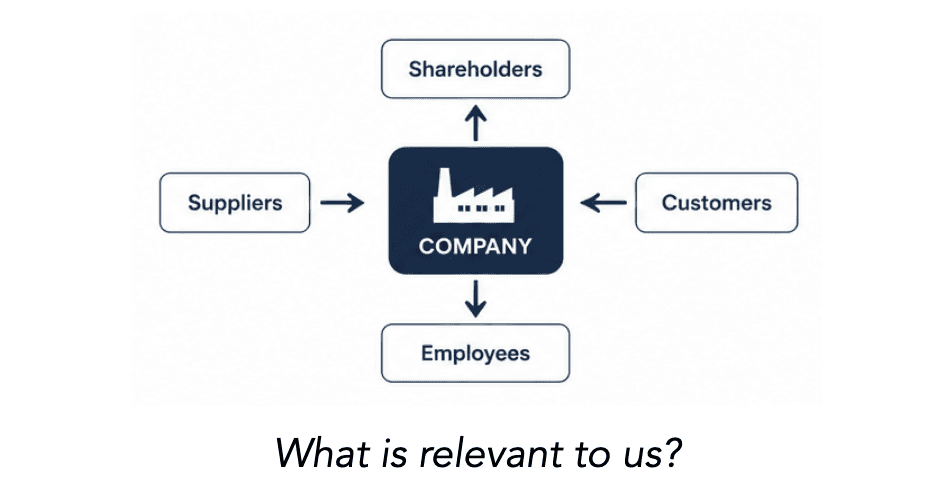
Organization B changed the map itself. The company was moved away from the center and purpose was placed there instead. Around that purpose were the company together with customers, employees, suppliers, owners, communities, competitors, the planet, and other actors relevant to what the organization was trying to achieve. Roche describes this as a shift from value chain to ecosystem, with the company becoming more of an “orchestrator of an ecosystem.”
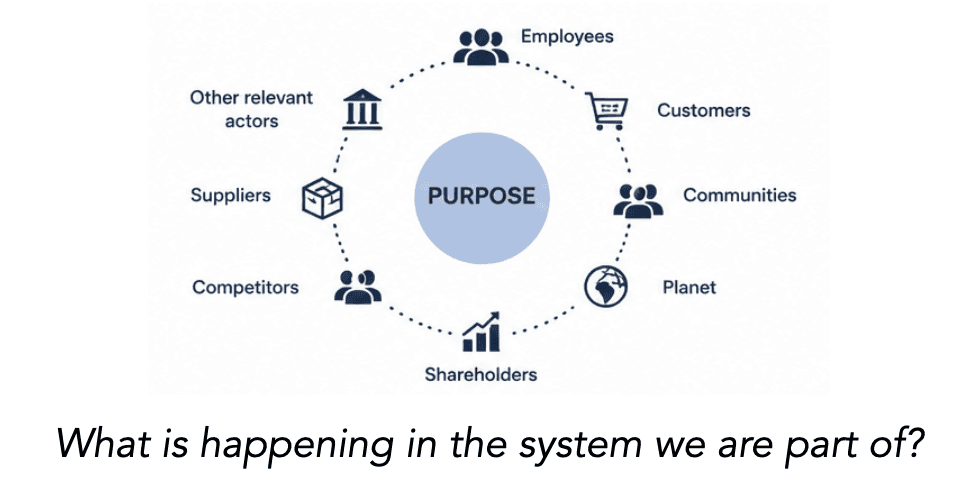
This also changed what the business was able to see. Through ecosystem mapping, it began identifying actors, pain points - concrete problems or needs - and systemic breakdowns - more fundamental failures in how the system functions - that would not have been visible if it had looked only at the traditional value chain. The next question was whether there were problems sufficiently close to the company’s purpose and capabilities for the organization to contribute to a commercially sustainable solution. In Roche’s examples, such problems could become starting points for innovation and new business, rather than simply issues for CSR (Corporate Social Responsibility), alongside the core business.
For me, this is the central lesson: what we see is influenced by where we place the organization in the picture. When the company is at the center, we naturally tend to see what is relevant to the company. When purpose is at the center, the map expands and we begin to see the wider system of which the company is already a part.
From “I” to “we”
This shift also connects with the work of economist Luigino Bruni and the Civil Economy tradition. Bruni draws on the idea of a “we-frame”, in which a person begins to understand herself as part of a collective actor. Faced with a decision, the question is no longer only what I should do, but “What shall we do?”
Bruni develops this movement from “I” to “we” at the individual level. Roche’s ecosystem perspective can be seen as a similar shift at the organizational level: from the company as the starting point to the wider system of which the company is a part.
The company does not disappear, nor do its own responsibilities, interests, or need for profitability. What changes is its understanding of itself. It begins to see that its own ability to flourish is connected to relationships and conditions that no single organization creates or controls on its own.
From a GreenGardens® perspective, this leads to something I see as central to the External Environment dimension: the organization has its own purpose, its own boundaries, and its own responsibilities, but it does not exist independently of the reality around it. Its employees come from society. Business transactions depend on trust and functioning institutions and the organization depends on infrastructure, knowledge, natural resources, and relationships that it did not create itself. At the same time, its own decisions affect the system on which it depends.
Seen in this way, the External Environment is not only about becoming better at reading changes outside the organization; it is about understanding where the organization sits within the larger picture.
Perhaps the deepest shift, then, is not simply from the inside out or from the outside in, but from “I” to “we”: from seeing the external environment as something surrounding the organization to understanding the organization as a participant in a shared social, economic, and ecological reality.

The Economy of Trust

When the Company Is No Longer at the Center

Impact & Value Creation - When Value Actually Becomes Value

Operation & Finance - Stewardship in Practice
Board & Governance - Guardians of Purpose and Responsibility

People & Values - The Inner Life of an Organization
Strategy Needs More Than Smartness

The Mission & Vision Dimension of the GreenGardens® Model
Restoring Dignity to Organizational Life
Why Organizational Problems Are Usually Systemic - And Why Most Measurement Tools Miss the Point
